
Magnesium anodes
Réf. DIP-006
Sacrificial magnesium anodes for the cathodic protection of buried structures or those in fresh water. Two alloys (1.55 V and 1.75 V), round or D-shape, supplied bare or pre-backfilled.
Magnesium anodes: overview
Among sacrificial anode materials, magnesium has the highest dynamic polarization potential. It is most often used for onshore installations, in resistive electrolytes where the use of zinc or aluminium would not be economical: onshore pipelines, buried storage tanks, water reservoirs, caissons and hulls in fresh or brackish water, or the temporary protection of pipelines before an impressed-current system is commissioned.
The anodes are available in two alloy types, with output potentials of around 1.55 V (low potential) and 1.75 V (high potential) relative to a copper/copper sulphate reference electrode, for a capacity of 1,230 Ah/kg. Two shapes are available: round (vertically cast) from 3.6 to 27.3 kg, or D-shape (horizontally cast) from 2.3 to 7.7 kg.
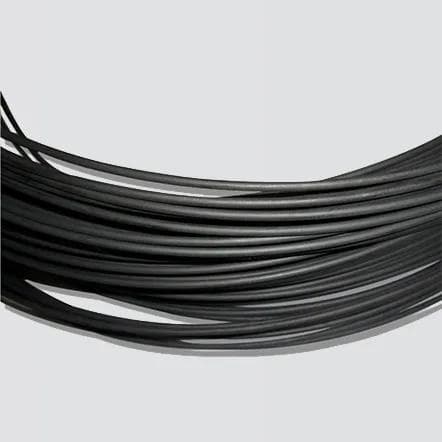
For buried pipelines and tanks, the anodes are generally supplied pre-conditioned in a cotton bag surrounded by backfill (75% gypsum, 20% bentonite, 5% sodium sulphate), which evens out the current output and dissolution rate while lowering the electrolyte resistance. The connecting cable is the customer's choice; we recommend 3 m of red KATHODICA™ cable, 6 mm² multi-strand copper, XLPE insulation and PVC sheath, rated 600/1000 V to IEC 502/83 and BS 5467.
Why magnesium rather than zinc or aluminium
A sacrificial anode only delivers current if its driving voltage can overcome the resistance of the surrounding medium. In resistive soil, zinc and aluminium no longer manage it; magnesium, with the most negative potential, keeps protecting. That is why it dominates onshore and freshwater applications, whereas the other two alloys belong mainly to the marine environment.
Low or high potential?
The high-potential alloy (about 1.75 V) provides extra driving voltage, useful in the most resistive soils. The low-potential alloy (about 1.55 V) is sufficient in more conductive soils and delivers current at a more measured rate there. A soil resistivity survey, carried out before sizing, guides the choice.
Why choose pre-backfilled anodes
Buried bare, an anode dissolves unevenly depending on the surrounding earth. The backfill surrounds it with a uniform, conductive medium: current output is steadier, consumption more even and anode-to-soil resistance lower. For a buried pipeline or tank, this is the version to choose.
Magnesium anodes: technical specifications
| Output potential (vs Cu/CuSO₄) | 1.55 V (low potential) or 1.75 V (high potential) |
| Electrochemical capacity | 1,230 Ah/kg |
| Available shapes | Round (vertically cast) or D-shape (horizontally cast) |
| Bare round anodes | 9 references from 3.6 to 27.3 kg (Ø 114 to 178 mm, length 193 to 1,528 mm) |
| Bare D-shape anodes | 5 references from 2.3 to 7.7 kg (length 305 to 850 mm) |
| Pre-backfilled versions | Cotton bag + backfill, gross weight 5 to 50 kg |
| Backfill composition | 75% gypsum, 20% bentonite, 5% sodium sulphate |
| Recommended cable | 3 m KATHODICA™ red, 6 mm² multi-strand copper, XLPE + PVC, 600/1000 V (IEC 502/83, BS 5467) |
Magnesium anodes: documentation
Request a price
Add this product to your request and send it all at once from the form.
Documentation


A cathodic protection project?
Our engineers are at your disposal to study your requirements and propose custom-built solutions.
Réponse rapide
Sous 48h
Expertise certifiée
Ingénieurs NACE
Support continu
Maintenance 24/7